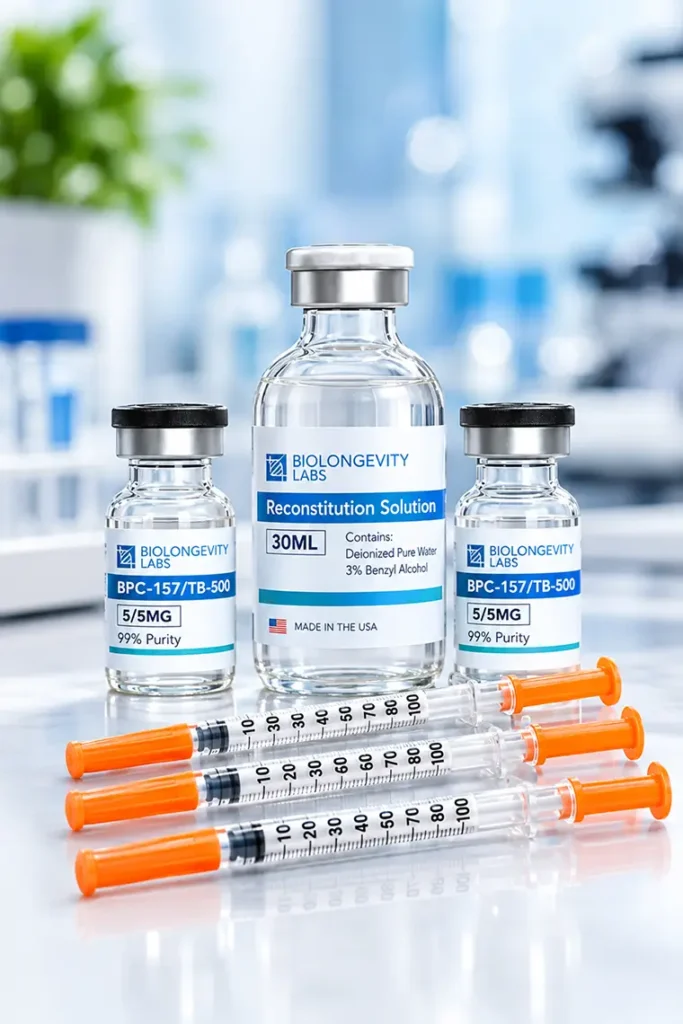
Peptide Calculator

Enter your vial size, the bacteriostatic water you are adding and your target dose. The calculator returns the exact units to draw on an insulin syringe, plus your concentration and how many doses the vial holds. Free, and no sign-up.

Last updated 15 September 2026

Pick your syringe by barrel size. The units you draw are identical on all three. Every U-100 insulin syringe uses the same scale, where one unit is 0.01 mL. A smaller barrel spreads a small dose over more space, which makes the tick marks easier to read. If you are not sure, use the 1 mL.

Result

Enter your vial size, bacteriostatic water and target dose to see the exact units to draw.

— units

On a 0.5 mL insulin syringe

—
Volume per dose
—
Concentration
—
Each unit contains
—
Doses per vial
Work with a practitioner who knows peptides to choose your dose, your schedule and how long you run it.
If you do not have one yet, here is how to find a doctor for peptide therapy.

Common Peptide Reconstitution Setups

These are the vial and water combinations people use most often. They are starting points for the math, not dose recommendations. Set your own dose with a qualified practitioner. Select any row to load it into the calculator. For the compound itself, start with the peptide guides.

Peptide Vial BAC water Concentration Dose Units (U-100) Doses / vial
The vial and water figures above are common lab conventions. Vial sizes vary by supplier, so read your own label before you mix.

How to Use This Peptide Calculator

Four inputs, one answer.
1

Enter the peptide in your vial, in milligrams

This is the number printed on the label. Common sizes are 5 mg, 10 mg and 20 mg.

2

Enter the bacteriostatic water you are adding, in milliliters

This is your choice, not a fixed value. It sets the concentration.
3

Enter your target dose

Use the mcg or mg toggle. 1 mg equals 1,000 mcg.
4

Choose your syringe

Pick the barrel size you own. The unit count does not change.

The calculator returns the units to draw, the volume in milliliters, your concentration in mg/mL, the micrograms in each unit, and how many doses the vial holds.

How the Peptide Dosage Math Works

The calculator runs three formulas. Here they are, so you can check the result by hand.

Concentration

mg / mL
Concentration (mg/mL) = peptide in vial (mg) ÷ bacteriostatic water (mL)

Units to draw on a U-100 syringe

Units
Units = ( target dose (mg) ÷ concentration (mg/mL) ) × 100

Doses per vial

Doses
Doses = ( vial size (mg) × 1000 ) ÷ target dose (mcg)
The 100 in the second formula comes from the U-100 insulin syringe standard.
A U-100 syringe holds 100 units in 1 mL, so one unit is always 0.01 mL.

Worked Example

You have a 10 mg BPC-157 vial. You add 2 mL of bacteriostatic water. You want a 500 mcg dose.
Change one input and watch what happens
Keep the same 10 mg vial and the same 500 mcg dose, but add 3 mL of water instead of 2 mL.
The concentration falls to 3.33 mg/mL and the same dose now reads 15 units.
The dose did not change. Only the measurement did.

Reading Your Insulin Syringe

One unit is 0.01 mL. That is true on every U-100 insulin syringe.
Insulin syringes come in three common barrel sizes.
They differ in how much they hold, not in how they are marked.
A 10-unit dose is 0.10 mL on all three.
The only practical difference is spacing.
A 0.3 mL barrel spreads 30 units over the same physical length that a 1 mL barrel uses for 100 units, so each tick mark sits further apart and small doses are easier to read.
Choose the smallest barrel that still fits your dose.

If you are new to injecting, how to take peptides covers technique, and peptide injection site reactions covers what is normal afterwards.

Injection is not the only way to take a peptide, and peptide routes of administration explains how injection compares with oral, nasal and topical use.

Barrel

Total capacity

Units it holds

Value of one unit

0.3 mL

0.3 mL

30 units

0.01 mL

0.5 mL

0.5 mL

50 units

0.01 mL

1.0 mL

1.0 mL

100 units

0.01 mL

How Much Bacteriostatic Water Should You Add?

Enough to make your dose easy to measure. That is the whole rule.

The water you add does not change how much peptide is in the vial. It changes how far that peptide is spread out, which changes how many units each dose works out to.

Most people use 1 mL to 3 mL. Work backwards from the tick marks: if your dose lands between marks, adjust the water until it lands on a whole unit.

A quick target to aim for is a dose that falls between 10 and 50 units. That range is easy to read and it leaves room in the barrel.

How to Reconstitute a Peptide Vial

Reconstitution means adding liquid to a freeze-dried peptide so it becomes a solution you can measure.
01

Bring both vials to room temperature

Reconstitution means adding liquid to a freeze-dried peptide so it becomes a solution you can measure.
02

Clean your workspace and your hands

Use gloves. Sterility protects the vial, which you will be opening repeatedly over several weeks.
03

Wipe both stoppers with an alcohol swab

Do the bacteriostatic water vial and the peptide vial. Let them dry.
04

Draw the water first

Pull your chosen volume of bacteriostatic water into a sterile syringe before you touch the peptide vial.
05

Add the water slowly, down the glass

Tilt the peptide vial to about 45 degrees and aim the stream at the inside wall. Do not fire it directly into the powder.
06

Swirl, do not shake

Roll the vial gently between your fingers until the solution runs clear. Shaking damages peptide structure and creates foam.
07

Label and refrigerate

Write the concentration and the mixing date on the vial. Store it at 2 to 8 degrees Celsius, away from light.
If the solution stays cloudy, is discoloured, or holds visible particles after several minutes of gentle swirling, do not use it.

For the longer version of this process, read the full peptide reconstitution guide.

Some compounds need extra care when you mix them, and how to reconstitute glutathione shows how to keep glutathione from oxidizing.

How to Store a Reconstituted Vial

Before mixing: lyophilised powder is stable at room temperature for short periods and tolerates shipping. For anything longer, store it at 4 degrees Celsius or below. For long-term storage, minus 20 degrees Celsius or colder
After mixing: refrigerate at 2 to 8 degrees Celsius. Most reconstituted peptides hold up for about 28 days at that temperature. Some are shorter. Check the guidance for your specific compound.
Protect it from light: keep the vial in its box or in an opaque container.
Do not freeze a reconstituted vial unless you are freezing single-use aliquots. Repeated freeze and thaw cycles degrade peptides.
Never share needles, and never re-enter a vial with a used needle.

For storage times at each temperature, before and after mixing, read the peptide storage and handling guide.

Bacteriostatic Water, Sterile Water and Saline

Use the diluent your supplier or your practitioner specifies.
Benzyl alcohol is not appropriate for everyone, and some peptides have solubility requirements that rule out one option or another.
What it is Multi-dose use Notes
Bacteriostatic water Sterile water with benzyl alcohol added as a preservative, 0.9% or 1.1% depending on the vial Yes The standard diluent for peptides. The preservative is what allows repeated entries into one vial over several weeks.
Sterile water Water for injection with no preservative No Dissolves the peptide fine, but a vial mixed with it is single-use and should not be stored.
Bacteriostatic saline 0.9% sodium chloride with a preservative Yes Used for some compounds. Follow the labelling for your specific peptide.

Peptide Blends: How to Calculate One Component

A blend vial holds two or more peptides in a fixed ratio. The calculator still works. You just run it on the total.

The two blends people ask about most are GLOW and KLOW. GLOW combines BPC-157, TB-500 and GHK-Cu. KLOW is the same three plus KPV. If you are deciding between them, read GLOW vs KLOW.

Each is sold as a single vial with a combined milligram total made up of set amounts of each component.
Because the components are mixed together in the powder, you cannot draw one without the others.
The ratio is locked at the point of manufacture, so check the mg breakdown on your own vial before you run the numbers.
How to run the numbers:
01

Use the total blend weight as your vial size

If the label reads 70 mg total, enter 70.
02

Enter your water and your target volume as normal

The calculator returns units for the whole blend.
03

Work out each component from the label ratio

Take the milligrams of each component listed on the label, divide by the blend total, and multiply by your dose.

Worked Example

A blend vial lists 50 mg of component A and 10 mg of component B, so 60 mg total. You add 3 mL of bacteriostatic water. Concentration is 20 mg/mL, or 200 mcg per unit of blend. You draw 10 units, which is 2 mg of blend. Component A is 50/60 of that, or 1.67 mg. Component B is 10/60, or 333 mcg.
Read the ratio off your own label.
Blend formulations differ between suppliers even when the product name is the same.

For blend dosing frequency and cycle length, see Jay’s protocols and the best peptide stacks guide.

Reverse Peptide Calculator

Two questions run the other way round.

How much water do I add so my dose lands on a round number of units?

ML
Water to add (mL) = ( vial size (mg) × target units ) ÷ ( target dose (mg) × 100 )
Example. You have a 10 mg vial and you want a 500 mcg dose to read as exactly 20 units. Water = (10 x 20) / (0.5 x 100) = 4 mL.

"I drew N units. How much peptide did I get?"

Mg
Dose (mg) = concentration (mg/mL) × ( units ÷ 100 )
Example. Your vial is at 5 mg/mL and you drew 14 units. Dose = 5 x 0.14 = 0.7 mg, or 700 mcg.

Mcg, Mg and IU

Micrograms and milligrams convert with a factor of 1,000.

International units (IU) are different. An IU measures biological activity, not weight, and the conversion is specific to each substance. There is no universal mcg-to-IU factor.

Use the IU figure printed on your own vial.

Do not convert from a different product's label.

Nasal sprays work on different volumes again, and peptide nasal spray vs injection covers the difference.

Troubleshooting

Your dose is more units than the syringe holds:

Add less water next time to raise the concentration, or move to a 1 mL syringe. Do not split one dose across two draws unless you have no alternative, because each extra entry into the vial is another contamination risk.

Your dose is under 2 units:

Add more water to dilute the solution and spread the dose over more tick marks. A 0.3 mL syringe also helps. Anything under 1 unit cannot be measured reliably.

Your dose falls between tick marks:

Round to the nearest half unit you can read with confidence, or adjust your water volume so the dose lands on a whole number. If it happens on every draw, change the water.

You already mixed the vial and the units are awkward:

Do not add more water to a vial that already contains peptide unless you recalculate the total volume. The concentration changes, and every previous calculation is void.

The powder will not dissolve:

Keep swirling gently and give it time. Some peptides take several minutes. If it still will not clear, or it looks cloudy or discoloured, do not use it.

Peptide Dosing Chart

Micrograms of peptide per syringe unit, at the concentrations used across Jay’s cheat sheet. Multiply by the units you draw.
Vial BAC water Concentration Per unit 5 units 10 units 20 units 30 units
2 mg 1 mL 2 mg/mL 20 mcg 100 mcg 200 mcg 400 mcg 600 mcg
2 mg 2 mL 1 mg/mL 10 mcg 50 mcg 100 mcg 200 mcg 300 mcg
5 mg 2 mL 2.5 mg/mL 25 mcg 125 mcg 250 mcg 500 mcg 750 mcg
5 mg 2.5 mL 2 mg/mL 20 mcg 100 mcg 200 mcg 400 mcg 600 mcg
5 mg 3 mL 1.67 mg/mL 16.67 mcg 83.33 mcg 166.67 mcg 333.33 mcg 500 mcg
10 mg 1 mL 10 mg/mL 100 mcg 500 mcg 1 mg 2 mg 3 mg
10 mg 2 mL 5 mg/mL 50 mcg 250 mcg 500 mcg 1 mg 1.5 mg
10 mg 3 mL 3.33 mg/mL 33.33 mcg 166.67 mcg 333.33 mcg 666.67 mcg 1 mg
15 mg 1 mL 15 mg/mL 150 mcg 750 mcg 1.5 mg 3 mg 4.5 mg
20 mg 2 mL 10 mg/mL 100 mcg 500 mcg 1 mg 2 mg 3 mg
20 mg 3 mL 6.67 mg/mL 66.67 mcg 333.33 mcg 666.67 mcg 1.33 mg 2 mg
50 mg 3 mL 16.67 mg/mL 166.67 mcg 833.33 mcg 1.67 mg 3.33 mg 5 mg
Every row assumes a U-100 insulin syringe, where one unit is 0.01 mL.
Want this on paper? Grab the free Peptide Cheat Sheet and keep it next to your vials.

Peptide Calculator FAQ

What is a peptide calculator?

A peptide calculator converts three inputs into a syringe reading. You give it the milligrams of peptide in your vial, the milliliters of bacteriostatic water you are adding and your target dose. It returns the exact number of units to draw on a U-100 insulin syringe, along with your concentration and how many doses the vial holds.

Divide the milligrams in the vial by the millilitres of water you add. That gives you the concentration in mg/mL. Divide your target dose in milligrams by that concentration, then multiply by 100 to get units on a U-100 syringe.
Most people use 1 mL to 3 mL. There is no fixed correct amount. The water sets the concentration, so the right volume is whichever one puts your dose on an easy-to-read part of the syringe. Aim for a dose that lands between 10 and 50 units.
No. The vial holds the same amount of peptide whatever you add. Water changes only how many units that dose works out to. A 250 mcg dose from a 5 mg vial is 10 units at 2 mL of water and 15 units at 3 mL. Both deliver 250 mcg.
Bring both vials to room temperature, wipe both stoppers with alcohol, draw your chosen volume of bacteriostatic water and add it slowly down the inside wall of the tilted peptide vial. Swirl gently until clear. For a 10 mg vial, 2 mL gives 5 mg/mL and 3 mL gives 3.33 mg/mL, which is why the water volume has to be recorded alongside the dose.
Jay’s cheat sheet uses 2 mL, which gives 5 mg/mL. At that concentration the listed 500 mcg dose is 10 units and the vial holds 20 doses. If you use 3 mL instead the concentration drops to 3.33 mg/mL and the same 500 mcg dose becomes 15 units.
That depends on your vial size, your water volume and your dose. Enter all three above and the calculator gives the exact unit mark. There is no single answer that applies to every peptide.
Pick by barrel size, not by unit count. A 0.3 mL syringe holds 30 units, a 0.5 mL holds 50 and a 1 mL holds 100. One unit is 0.01 mL on all three, so a given dose is the same number of units on any of them. Smaller barrels spread the marks further apart, which helps with small doses
Divide by 1,000. 250 mcg is 0.25 mg, and 1 mg is 1,000 mcg. A 5 mg vial contains 5,000 mcg.
Bacteriostatic water is sterile water with benzyl alcohol added as a preservative, listed as 0.9% or 1.1% depending on the vial. The preservative stops bacterial growth, which is what makes it safe to re-enter the same vial over several weeks. It is the standard diluent for peptide reconstitution.
Sterile water dissolves the peptide, but it has no preservative. A vial mixed with sterile water is meant for single use and should not be stored. Use bacteriostatic water for any vial you plan to use more than once.
Roughly 28 days refrigerated at 2 to 8 degrees Celsius, for most peptides. Some are shorter. Keep the vial cold, keep it out of the light and check the guidance for your specific compound.
Round to the nearest half unit you can read reliably, or change your water volume so the dose lands on a whole number. If it keeps happening, add more water. A more dilute solution spreads the dose over more tick marks.
Use the total blend weight as your vial size. The calculator gives you units for the whole blend. To find one component, take its milligrams from the label, divide by the blend total and multiply by the dose you drew.
Yes. The math is the same for any lyophilised compound where you know the vial size, the water volume and the target dose. A 10 mg tirzepatide vial with 2 mL of water is 5 mg/mL, so a 0.5 mg dose is 10 units.

No. It converts a dose you already have into syringe units. It does not set your dose, confirm that a peptide is right for you, or replace a qualified practitioner. Work with a practitioner who knows peptides before you start, and read how to find a doctor for peptide therapy if you need one.

Where to get research peptides

BioLongevity Labs manufactures its research peptides and Khavinson bioregulators in the USA. No fillers, and a certificate of analysis on every batch.

New to peptides? Start with Jay’s peptide protocols.

Use Code JAYC for 15% off

Disclaimer

This calculator performs unit-conversion math on the values you enter. It is provided for educational and research purposes. It is not medical advice, and it does not recommend any peptide, dose or protocol. Many peptides are sold for laboratory research only, are not approved for human use, and may be regulated where you live. Speak to a qualified healthcare practitioner before you start, stop or change any peptide, medication or supplement. These statements have not been evaluated by the FDA.
Scroll to Top