
 Written by Jay Campbell





[Disclaimer: This article is for educational purposes only. Always consult with a qualified healthcare provider before starting any peptide protocol.]
Most of what you’ve been told about hair regrowth is either pharmaceutical propaganda or wishful thinking disguised as science.
The establishment wants you dependent on Finasteride (with its well-documented sexual side effects) or minoxidil (which works… until it doesn’t).
Meanwhile, the supplement industry pushes supplements like biotin and saw palmetto that barely move the needle.
But there’s a third category which doesn’t seem to be a part of the conversation:
Therapeutic peptides designed to target the biological mechanisms responsible for the regulation of hair follicle cycling.
After three decades studying hormone optimization and peptide therapeutics, I can definitively say the science for peptide-induced hair growth is compelling.
There are specific peptides that are commonly used in transdermal hair formulations right now, and they’re producing results the medical establishment doesn’t know about (yet).
This breakdown shows you the peptides currently being used in professional hair regrowth protocols, what the data actually supports, and why high-dose collagen may be a smarter move than low-dose Finasteride.
Quick Takeaways
- The primary peptides used in transdermal hair formulations are GHK-Cu, AHK peptides, Snap-8, and Matrixyl
- GHK-Cu is the strongest individual peptide for hair health, stimulating follicle growth through Wnt/β-catenin activation
- Fish collagen peptides at high doses (1000 mg/kg) matched Finasteride in animal models
- APN5 peptide showed extreme potency in rats, outperforming minoxidil by concentration (a ~400x potency advantage)
- Multi-component peptide formulations have published human clinical data, showing a 25-34% increase in density at 90 days
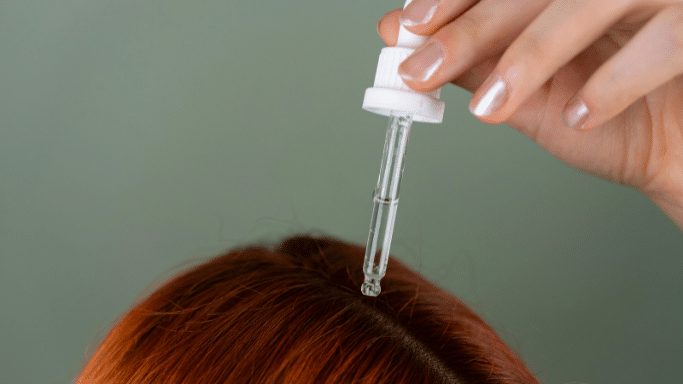
The Primary Peptides for Hair Growth
Before we get into the science and finer details, let me tell you what’s actually being used in professional hair growth protocols right now.
If you talk to any formulation chemist working on transdermal hair products, these are the peptides they’re building their solutions around:
GHK-Cu (Copper Peptide): The Cornerstone
GHK-Cu is the single most important peptide in hair growth formulations, and it’s the one I’d start with if you could only choose one.
This copper-binding peptide was discovered in 1973 and has decades of regenerative research behind it.
Here’s what GHK-Cu does for hair at the molecular level:
- Activates Wnt/β-catenin signaling, which is the master switch of follicle cycling.
- Stimulates follicular growth factors and accelerates the anagen (growth) phase of hair.
- Possesses angiogenic properties that promote new blood vessel formation, which increases blood flow to the follicles and dermal papilla.
- Boosts the production of collagen and elastin in scalp tissue.
- Inactivates free radical by-products of lipid peroxidation, protecting follicles from oxidative stress damage.
In one mouse study, hair entered the growth phase in 6 days with GHK-Cu treatment, compared to 9 days for pharmaceutical controls.
This degree of cycle activation is even faster than the drugs your dermatologist is prescribing.
Research published in the Journal of Investigative Dermatology showed GHK-Cu doubled follicle size and increased hair follicles by 80% in the anagen phase over 3-4 months in rats.
And researchers from Yale University discovered copper peptides boost the production of fat cells in the scalp, which strengthens hair follicles and triggers growth signals.
GHK-Cu also has potent anti-inflammatory properties — and inflammation plays a MAJOR role in androgenetic alopecia.
Researchers have come to the following conclusion: GHK is a safe, inexpensive, and extensively studied compound with a wealth of positive and health-promoting effects in many biological systems.
GHK-Cu is also a key component of the GLOW peptide protocol (BPC-157 + TB-500 + GHK-Cu), which targets regenerative pathways and is already demonstrating great promise systemic tissue repair.
AHK Peptides: The Vascular Booster
AHK-Cu (L-alanyl-L-histidyl-L-lysine-Cu2+) is naturally found in the bloodstream and is considered an essential element in hair development.
While GHK-Cu is the heavy hitter for follicle activation, AHK peptides shine in their ability to promote blood vessel growth and improve vascular supply to existing follicles.
AHK-Cu works by boosting the number of fibroblasts and activating vascular endothelial growth factor (VEGF) production, which promotes elongation of hair follicles and the proliferation of dermal papilla cells.
It also inhibits the secretion of transforming growth factor-beta1 in fibroblasts, reducing the oxidative stress that increases DHT production.
Plus, it helps produce superoxide dismutase (SOD), leading to a neutralization of the free radicals that lead to follicle damage and hair loss.
In rodent studies, AHK-Cu increased blood supply to existing hair follicles, resulting in thicker and longer hair.
Think of it this way: GHK-Cu activates the follicle, and AHK brings the blood supply to feed it.
This makes both peptides complementary to one another, rather than antagonistic.
Snap-8: The Scalp Tension Reducer
Snap-8 (acetyl octapeptide-3) is best known in the skincare world for its Botox-like effects on expression lines.
But here’s why it matters in the context of hair loss and hair regrowth…
Snap-8 inhibits the SNARE complex involved in muscle contraction, thereby reducing scalp tension and microinflammation within the follicular environment.
Scalp tension is an underappreciated driver of androgenetic alopecia. Tight, inflamed scalp tissue restricts blood flow and creates a hostile environment for follicle cycling.
By relaxing the muscular tension in the scalp, Snap-8 creates a more permissive environment for other peptides (like GHK-Cu and AHK) to do their work.
It’s not a standalone hair growth peptide, but definitely serves useful as a formulation enhancer that improves the conditions under which hair growth peptides operate.
For this reason, knowledgeable formulators are including it in their transdermal hair protocols.
Matrixyl: The Collagen Matrix Builder
Matrixyl (palmitoyl pentapeptide-4) and its advanced variant Matrixyl 3000 (palmitoyl tripeptide-1 + palmitoyl tetrapeptide-7) are signal peptides that tell your cells to produce more collagen and repair the extracellular matrix.
This matters for treating hair loss because the dermal-epidermal junction (DEJ) and the extracellular matrix surrounding hair follicles provide the structural scaffolding necessary for the follicles to cycle properly.
As we age, this matrix degrades, and follicles lose the structural support they need.
Matrixyl peptides stimulate collagen synthesis, increase glycosaminoglycan production, and reduce inflammation that breaks down the follicular microenvironment.
Do a quick Google search of any of these peptides, and you’ll find a wealth of published research supporting their mechanisms.
They are well-characterized peptides being actively used in transdermal hair formulations by clinicians who understand the science.
Just like SNAP-8, you can think of them as structural repair peptides responsible for rebuilding the biological foundation required for stopping hair loss.

Fish Collagen Peptides vs. Finasteride: Why Higher Doses Beats Lower Doses
Now, let’s talk about one of the most important comparisons in hair growth science.
In a 6-week C57BL/6 mouse study, oral fish collagen peptides at 1000 mg/kg produced regrowth results COMPARABLE to finasteride at 1 mg/kg.
A much higher dose of fish collagen — a naturally derived protein with essentially zero side effect profile — matched the results of a pharmaceutical drug known to cause sexual dysfunction, depression, brain fog, and hormonal disruption.
Here are the mechanisms powering the results generated by fish collagen peptides:
- Upregulating IGF-1
- Increasing VEGF production
- Elevating Ki67 proliferation markers
- Downregulating TGF-β1 (a growth inhibitor)
- Suppressing BMP signaling
- Activating Wnt/β-catenin signaling
This is the SAME Wnt/β-catenin master switch activated by GHK-Cu!
The treatment increased total follicle count and shifted follicles into anagen phase.
And since the results were dose-dependent, this provides further evidence of real biological activity.
With all of this in mind, here’s the argument that nobody in mainstream dermatology is willing to make:
Why would you take a small dose of a drug that suppresses DHT by blocking 5-alpha reductase, with documented side effects that include erectile dysfunction, decreased libido, depression, and persistent sexual dysfunction even after discontinuation…
… when you could take a much higher dose of fish collagen peptides known to activate the same growth pathways through a completely different mechanism, and with essentially no side effects?
The pharmaceutical model wants you to take the lowest dose of the most powerful drug.
Understandable, given my motto of “Start low and go up slowly.”
But the optimization model flips this upside down, recommending a generous amount of a naturally derived compound that works through multiple synergistic pathways without disrupting your hormonal axis.
Because when you systematically suppress DHT through the use of Finasteride, you’re not only affecting your scalp.
You’ll also experience downstream and unwanted effects on your prostate, your sexual function, your brain, and your mood.
Fish collagen peptides, on the other hand, activate growth signaling locally without touching your vital hormonal cascade.
Granted, the collagen data I just quoted is from animal models and there are no human clinical trials evaluating the use of fish collagen peptides right now.
But the mechanistic plausibility is strong, the safety profile looks clean, and the dose-response relationship is firmly established.
If you’re a man on testosterone optimization therapy, the LAST thing you want to use is a drug that interferes with your androgen metabolism!
Fish collagen gives you a pathway to support hair growth where you get to work WITH your hormonal optimization, rather than against it.

APN5 Peptide: The High-Potency Wild Card
APN5 is lesser known compared to the other peptides mentioned thus far, but the potency data is striking.
Discovered by research teams at Seoul National University, APN5 binds to adiponectin receptors and promote hair growth while suppressing androgenetic alopecia.
In rat models, 0.007% APN5 produced hair growth effects comparable to 3% minoxidil.
To put these results into perspective, this finding represents a ~400x potency advantage on a concentration basis.
APN5 penetrates skin effectively and promotes growth in vivo by activating adiponectin receptor signaling… a completely different pathway from the previous peptide-based approaches I just mentioned.
But just like the fish collagen peptides, we’re lacking human data on top of limited commercial sourcing and a mechanism of action without any clinical validation.
APN5 is an exciting early-stage approach worth watching, but not something I would bet any amount of money on right now.

Multi-Component Peptide Formulations: The Only Human-Proven Option
Let’s move away animal data and start looking at human data instead.
A single-center human trial (N=50) tested a peptide-based topical serum protocol combined with peptide shampoo, conditioner, and oral support.
Here were the results after 90 days of use:
- Terminal hair density increased by 25%
- Terminal hair count increased by 25%
- Overall hair density increased by 34%
- 100% of participants reported decreased shedding of hair
- 89% reported a visible improvement after 30 days of treatment
These findings included male pattern hair loss, female pattern hair loss, AND scarring alopecia.
In a separate study published by The Journal of Clinical and Aesthetic Dermatology, women with thinning hair who took oral peptides twice a day for 90 days showed improved scalp coverage and thickness, as well as increased hair volume.
After 180 days, hair became shinier, smoother, and better moisturized.
But in all fairness, there are some caveats worth noting:
- Small sample size
- Lack of a placebo group
- A 90-day follow-up (you would want something at 180 days at beyond to validate the treatment’s longer-lasting effects, if any)
- A multi-product protocol where it is not clear which component(s) were responsible for the results.
However, this is the ONLY peptide-based strategy with objective human data as of this writing.
And it confirms what the mechanistic research in preclinical models have shown: Multi-peptide formulations targeting multiple pathways simultaneously can produce the best results for the treatment of hair loss.

Building a Protocol That Makes Sense
If I were building a hair growth protocol today, here’s how I’d go about doing it.
FIRST, optimize your hormones before touching peptides.
Hair loss driven by hormonal dysfunction, thyroid issues, chronic inflammation, severe nutrient deficiencies, and/or autoimmune processes will NOT be resolved with peptides alone.
You must address your testosterone levels, thyroid function, inflammation control, protein intake, and androgen balance before expecting peptides to work their magic.
FOR TOPICAL USE, I would opt for a transdermal protocol built around the four primary peptides: GHK-Cu, AHK, Snap-8, and Matrixyl.
They cover follicle activation, vascular support, scalp environment optimization, and extracellular matrix repair.
FOR ORAL USE, I would use high-dose fish collagen peptides for systemic Wnt/β-catenin activation and the growth factor support.
As I stated before, this is a far smarter choice than Finasteride for anyone who values their hormonal health.
FOR EXPERIMENTAL USE, you can add in APN5 provided you can get it from a reliable source.
But make sure you set realistic expectations and objectively track key markers of hair loss/growth.
After all, you are running an N=1 experiment, even with a clinically approved formulation of APN5.
And just before I end the article, remember this: Peptides can amplify biological pathways, but they CANNOT over-ride a broken physiology!
Critical Warnings: Final Thoughts About Using Peptides For Hair Growth
Head-to-head comparisons between these peptides in human subjects are very few in number.
Anyone claiming a single peptide is definitively “the best” is probably selling you something.
I will also note some peptides discussed online — especially GLP-1 receptor agonists — show observational reports of hair LOSS rather than regrowth.
However, keep in mind this hair loss is driven by rapid hair loss paired with inadequate intake of protein and micronutrients, rather than a direct effect of the GLP-1 receptor agonists themselves.
But regardless of which peptides you use to treat hair loss, and what biological pathways they affect, sourcing matters.
Just as you wouldn’t put low-grade fuel in a precision engine, you sure wouldn’t put anything less than the purest peptides in your body.
That’s why source quality and manufacturing standards matter.
I’ve personally vetted dozens of peptide suppliers, and I can tell you this without hesitation: BioLongevity Labs sets the benchmark for authentic therapeutic peptides, with a ruthless focus on stringent third-party testing and top-notch customer service.
They consistently deliver the highest quality products, trusted by professionals for both personal and clinical use.
Whether you’re looking to elevate your performance or integrate these products into research applications, BioLongevity Labs is a reliable source you can count on.
👉 Click here to place your online order for premium peptides 👈
Use code JayC to get 15% off your order!
I also invite you to join me and other like-minded biohackers in The Fully Optimized Health Private Membership Group.
You’ll receive guidance from myself and an elite group of more than 700 male and female biohackers (who all started out just like you).
And don’t forget to check out my premium educational content dedicated to helping you fully optimize your health:
Quantum Peptides – the A-to-Z system for anyone (newbies & pros alike) desiring to master peptide use for the first time and forever.
Quantum Testosterone – the A-to-Z system for Men & Women to learn to optimize their hormones for explosive energy, lean muscle, and timeless vitality.
The Ultimate GLP-1 Video Masterclass – how to PROPERLY utilize the world’s most powerful weight loss drugs for enhanced fat loss and overall longevity.
The Modern Woman’s Peptide Course – a must-have resource for any woman seeking to become more feminine, sexier, leaner, and healthier through the use of peptides.
Life Enhanced – Unlock the secrets to TOTAL Mind-Body-Spirit Optimization as Hunter Williams and I teach you how to live at the tip of the spear.
30 Days 2 Shredz – Reprogram Your Mind and Body for Maximum Fat Loss in Minimum Time with our Optimized Fasting Protocol
Monica Campbell’s 3 Day PMF Video Training Program – Ignite unbreakable strength, sculpt lean muscle, and conquer workouts fearlessly with my wife Monica’s 3 Day Video training course.
Positive Muscle Failure Video Training Program – Learn how to lift weights correctly for maximum muscle in minimum time while building the physique of your dreams.
See you on the inside!